HMI Magazine Review: Behind the music, costumes and flags, the West Indian Day Parade remains a powerful statement of Caribbean identity—but violence, immigration anxiety and increasingly restrictive security measures are forcing difficult questions about its future.
By HMI Magazine
BROOKLYN, N.Y. — September 2026
For one day every Labor Day weekend, Eastern Parkway becomes something larger than a Brooklyn boulevard.
It becomes Trinidad and Tobago, Haiti, Jamaica, Grenada, Barbados, Guyana, St. Lucia, Dominica, Antigua and Barbuda, St. Vincent and the Grenadines and virtually every corner of the Caribbean at once.
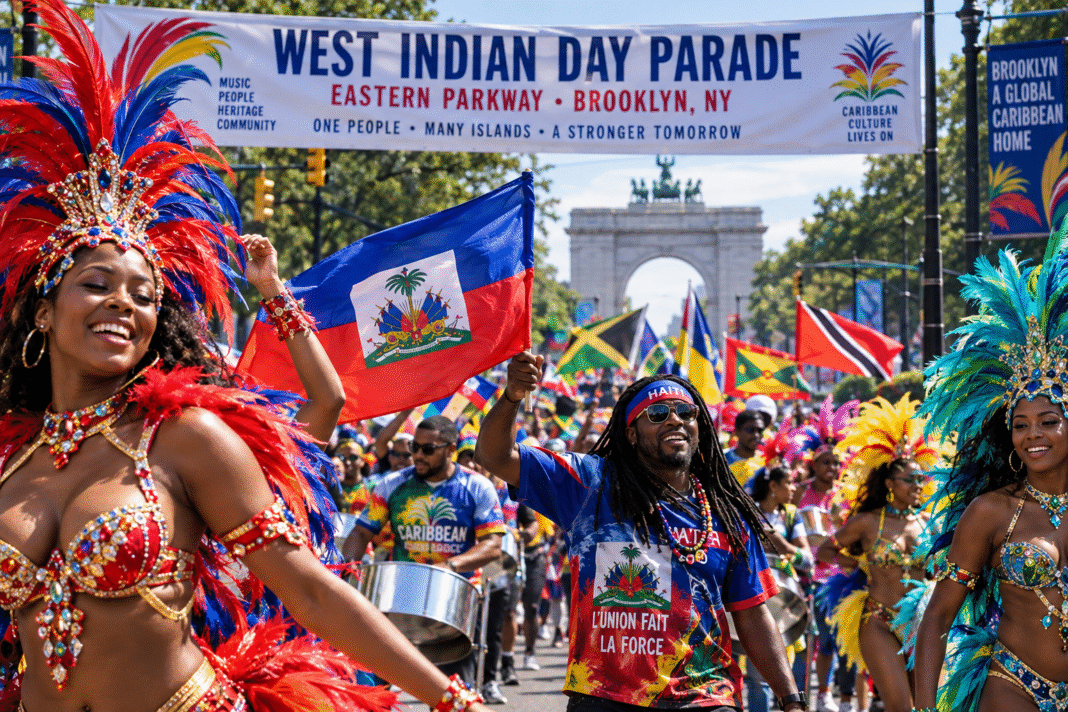
On Monday, September 7, hundreds of thousands of people returned to Brooklyn for the 2026 West Indian American Day Parade, filling Eastern Parkway with steel pan, soca, calypso, reggae, dancehall, Haitian Konpa and Raboday, elaborate masquerade costumes, national flags and Caribbean food.
But the 2026 celebration also revealed the complicated reality surrounding one of New York City’s greatest cultural institutions.
This was a Carnival of tremendous beauty.
It was also a Carnival surrounded by thousands of police officers, double barricades, surveillance, security restrictions and renewed violence.
It was cultural.
It was political.
It was joyful.
At moments, it was troubling.
And understanding the West Indian Day Parade requires acknowledging all of those realities simultaneously.
MORE THAN A PARADE
Calling the Eastern Parkway celebration simply a parade understates what it represents.
The modern New York Carnival traces its history to Caribbean immigrants who organized celebrations in Harlem beginning decades ago before the festivities eventually established their home in Brooklyn.
Today, the West Indian American Day Carnival Association, or WIADCA, describes the event as the largest Caribbean Carnival in North America.
But Carnival itself reaches much further back.
Its Caribbean development carries histories of colonialism, slavery, emancipation, African cultural survival and resistance. Masquerade, music and street celebration became ways for people of African descent to reclaim public space and express identities that colonial systems attempted to suppress.
That history remains embedded in J’Ouvert and Carnival today.
The feathers are beautiful.
The music is infectious.
The dancing is joyful.
But underneath the spectacle is something much deeper:
the right of Caribbean people to be visible.
On Eastern Parkway, immigrants and their descendants do not have to minimize their accents, flags, food, rhythms or identities.
For several hours, Caribbean culture occupies one of America’s largest cities unapologetically.
THE SOUND OF THE CARIBBEAN TAKES OVER BROOKLYN
Musically, the parade remains extraordinary because there is no single West Indian sound.
Steel pan recalls Trinidad and Tobago’s enormous contribution to Caribbean musical culture.
Soca turns sections of the Parkway into moving dance floors.
Reggae and dancehall carry Jamaica’s globally influential musical language.
Haitian Konpa and Raboday announce Haiti’s presence.
Different islands arrive with their own rhythms, costumes, dialects and traditions, yet somehow they coexist inside one enormous celebration.
That may be the musical genius of Eastern Parkway.
The festival does not erase national identities in order to create Caribbean unity.
It allows those identities to stand next to one another.
A Trinidadian can wave the red, black and white.
A Haitian can carry the blue and red.
A Jamaican can wear black, green and gold.
A Grenadian can proudly display the colors of Grenada.
They remain different while simultaneously belonging to something larger.
That is Caribbean identity in New York.
FOR HAITIANS, 2026 FELT DIFFERENT
For New York’s Haitian community, this year’s celebration carried particular emotional and political significance.
Associated Press reporting described a more somber atmosphere surrounding Haitian participation because of intensified immigration enforcement and the loss of Temporary Protected Status protections affecting hundreds of thousands of Haitians.
That transformed participation into something more meaningful than entertainment.
Haitian masquerade groups including Lespri Ayiti used Carnival to assert identity at a moment when many Haitian immigrants are confronting uncertainty about their future in the United States.
Haitian presentations incorporated revolutionary history, including imagery connected to Jean-Jacques Dessalines, alongside celebrations of contemporary Haitian culture.
Konpa and Raboday provided the soundtrack.
The Haitian flag remained visible.
And the message was difficult to miss.
A community facing enormous challenges in Haiti and uncertainty in the United States was still standing.
For Haitian New Yorkers, therefore, Eastern Parkway became both celebration and declaration.
We are here.
WHEN CULTURE BECOMES POLITICAL POWER
The West Indian Day Parade is also one of New York’s most important annual political stages.
That is not accidental.
Caribbean Americans represent an important constituency in Brooklyn and across New York City. Generations of immigrants from Jamaica, Haiti, Trinidad and Tobago, Guyana, Grenada, Barbados and elsewhere have become voters, homeowners, business owners, educators, clergy members, union members, activists and elected officials.
Politicians understand the significance of Eastern Parkway.
Mayor Zohran Mamdani and Gov. Kathy Hochul were among the prominent political figures participating in the 2026 celebration, both appearing as honorary grand marshals.
The mayor described the parade as a celebration not only of freedom but of a Caribbean diaspora that has contributed enormously to New York.
Hochul used the occasion to address another issue weighing heavily on immigrant communities: federal immigration enforcement. She publicly pledged opposition to what she characterized as excessive ICE enforcement affecting Caribbean neighborhoods.
Those statements demonstrate why Carnival has evolved into something beyond culture.
Eastern Parkway is also political territory.
Candidates and elected officials want to be seen there because Caribbean New Yorkers possess political influence.
That visibility is positive when it produces genuine engagement with Caribbean communities.
But HMI Magazine believes an important distinction must remain.
Carnival should provide Caribbean communities with political power; politicians should not be allowed to turn Carnival into political advertising.
The community must remain the center of the event.
THE GOOD: A CULTURE TOO POWERFUL TO DISAPPEAR
At its best, the 2026 Carnival demonstrated everything that makes Eastern Parkway special.
Families came together.
Children saw their heritage celebrated publicly.
Immigrants encountered flags from countries they left decades ago.
Second- and third-generation Caribbean Americans connected with traditions they inherited from parents and grandparents.
Musicians performed.
Masqueraders transformed the Parkway with elaborate costumes.
Food vendors turned Caribbean culinary traditions into economic opportunity.
Small businesses received enormous exposure.
And communities that sometimes remain separated by island identity celebrated together.
This matters.
Diaspora communities survive through transmission.
Language must be transmitted.
Music must be transmitted.
Food must be transmitted.
History must be transmitted.
Carnival helps perform that work in public.
A child born in Brooklyn may never experience Carnival in Port of Spain, Kingston or Port-au-Prince exactly as a parent or grandparent remembers it.
But on Eastern Parkway, that child can still encounter a living connection to the Caribbean.
That cultural inheritance is priceless.
THE BAD: VIOLENCE AGAIN INTRUDES
Unfortunately, it is impossible to review the 2026 celebration responsibly without addressing violence.
City officials entered Labor Day weekend determined to prevent a repeat of previous incidents.
NYPD Commissioner Jessica Tisch said six people had been shot in three incidents on or near the parade route during the previous year’s celebration, including incidents occurring around the period when crowds were dispersing.
That history influenced the decision to end the 2026 parade promptly at 5:30 p.m.
Yet violence still occurred around this year’s festivities.
Local reporting documented multiple stabbing and slashing victims around the J’Ouvert period, followed later by shootings near the parade route. Three people were reported shot in incidents near Eastern Parkway, with victims reported in stable condition.
Those facts cannot be dismissed.
But they also require perspective.
Hundreds of thousands of people participated peacefully.
The actions of a comparatively tiny number of individuals should never become the identity of an entire Caribbean community.
There is a dangerous tendency for violence associated with large Black cultural gatherings to overwhelm coverage of everything else that occurred.
That is unfair.
At the same time, simply accusing the media of negativity cannot substitute for confronting a genuine public-safety problem.
Both things can be true.
The overwhelming majority of Carnival participants are peaceful—and recurring shootings and stabbings around the celebration remain unacceptable.
Caribbean communities deserve better than having their largest celebration repeatedly associated with violence caused by a few individuals.
SECURITY: NECESSARY PROTECTION OR TOO MUCH CONTROL?
The city’s response was enormous.
Ahead of the festival, officials described the operation as one of the NYPD’s largest deployments of the year.
Thousands of officers were assigned to J’Ouvert and the West Indian Day Parade.
For J’Ouvert, spectators entered through 13 controlled access points and passed through magnetometer screening.
The city also deployed Emergency Service Unit personnel, aviation and mounted units, K-9 teams, counterterrorism resources, intelligence officers, bomb-squad personnel, cameras and drones.
Community-based violence-interruption groups were incorporated as well. The city’s Crisis Management System deployed hundreds of staff members and volunteers across expanded safety zones, with mobile trauma resources positioned around gathering areas.
For the main parade, officials experimented with different barrier configurations, including the highly visible double barricades separating spectators from marchers.
From a public-safety perspective, the reasoning is understandable.
From a cultural perspective, the consequences are more complicated.
Carnival depends upon proximity.
People interact with masqueraders.
Spectators dance.
Friends recognize one another.
Performers feed off the crowd.
The street itself becomes part of the performance.
When police barriers create a large physical separation between performers and spectators, something changes.
Several paradegoers complained publicly that the additional barriers made the celebration feel more restrictive and reduced interaction with masqueraders.
Others welcomed the security and believed stronger enforcement discouraged trouble.
Both reactions deserve consideration.
Safety cannot be optional.
But neither should Carnival gradually become something people merely observe from behind layers of steel.
THE SECURITY PARADOX
This creates perhaps the most difficult question facing organizers.
How do you protect Carnival without suffocating Carnival?
The answer cannot simply be more police every year.
Eventually, there is a point at which a street festival surrounded by overwhelming security infrastructure begins losing some of the spontaneity that made it culturally important.
But eliminating security while recurring violence remains a concern would be irresponsible.
The more promising part of the city’s 2026 strategy may therefore have been its investment in community-based intervention.
Violence interrupters, local organizations, clergy, neighborhood leaders and crisis teams can sometimes intervene in conflicts before they become police matters.
That model recognizes an important reality:
Carnival safety cannot be produced exclusively by law enforcement.
It must also be produced by the community.
J’OUVERT MUST ALSO BE UNDERSTOOD CULTURALLY
J’Ouvert frequently receives attention primarily when something goes wrong.
That misses its historical importance.
The predawn celebration carries traditions connected to emancipation, masquerade, resistance and the transformation of colonial symbols through African-Caribbean expression.
Mud, paint, powder, chains, horns and traditional characters are not simply random street-party accessories.
They belong to a cultural vocabulary.
Separating J’Ouvert entirely from that history makes it easier for outsiders to see only disorder.
But protecting its cultural integrity also requires participants to reject individuals who use the celebration as cover for violence.
Preserving tradition and demanding safety are not competing objectives.
They should reinforce each other.
AN ECONOMIC ENGINE THAT DESERVES MORE ATTENTION
There is another side of Carnival that receives considerably less attention: economics.
Hundreds of thousands of visitors mean customers.
Restaurants benefit.
Street vendors benefit.
Costume designers benefit.
Musicians, DJs, sound companies, photographers, transportation providers and local businesses benefit.
Carnival culture itself represents an economy.
Mas is design.
Music is intellectual property.
Food is entrepreneurship.
Performance creates employment.
Tourism creates revenue.
The Caribbean community should therefore think beyond celebrating Carnival and increasingly consider how to own more of the economic ecosystem surrounding Carnival.
Cultural influence without economic participation leaves enormous value on the table.
WIADCA IS MORE THAN LABOR DAY
The West Indian American Day Carnival Association also argues that its role extends beyond producing one annual parade.
WIADCA President Roger Archibald emphasized before the 2026 celebration that the volunteer organization operates community programs throughout the year, including activities involving young people, senior citizens, food assistance and steel-pan education.
That matters because Carnival organizations cannot survive solely as event producers.
If the tradition is going to remain meaningful for another generation, organizations must cultivate musicians, costume makers, dancers, organizers and audiences throughout the year.
The future of Carnival will be decided partly by whether young Caribbean Americans see it as their culture—not simply something their parents attend every Labor Day.
HMI MAGAZINE REVIEW: THE GOOD AND THE BAD
THE GOOD
The cultural presentation remained extraordinary. Caribbean nations displayed their individual identities while participating in a shared diaspora celebration.
The music remained the festival’s heartbeat, from soca and steel pan to reggae, dancehall, Konpa and Raboday.
Haitian participation carried particular significance this year, turning cultural visibility into an expression of resilience during a period of immigration uncertainty.
The massive attendance demonstrated that Caribbean culture remains deeply embedded in New York City.
And the presence of leading elected officials confirmed something Caribbean communities should recognize clearly:
Eastern Parkway represents political power.
THE BAD
Violence once again contaminated the story.
Even though the overwhelming majority of participants celebrated peacefully, shootings, stabbings and slashings around the festivities gave critics another reason to question safety.
The heavy security response created another problem. Double barricades and an enormous police presence may have increased control, but they also reduced the intimacy between spectators and performers that gives Carnival its distinctive street character.
There is also a risk of excessive political presence transforming a cultural celebration into an annual campaign stop.
Carnival should welcome elected leaders.
It should never belong to them.
HMI MAGAZINE OVERALL GRADE: B+
Culture & Heritage:
A+
Few events in North America display Caribbean identity on this scale.
Music & Entertainment:
A
The diversity of Caribbean sounds remains one of the celebration’s greatest strengths.
Community & Diaspora Impact:
A+
Eastern Parkway remains an extraordinary meeting place between immigrants, their children and their ancestral homelands.
Haitian Cultural Representation:
A
Haitian participation carried unusual emotional and political weight in 2026.
Political Significance:
A
The attendance of major elected officials demonstrated the growing influence of Caribbean New Yorkers.
Organization & Security:
B
The city clearly invested enormous resources, but the experience showed the difficult tradeoff between safety and maintaining Carnival’s openness.
Public Safety:
C
Any recurring pattern of shootings and stabbings around a major family cultural celebration remains a serious concern, even when the perpetrators represent only a tiny fraction of attendees.
Overall:
B+
HMI MAGAZINE VERDICT
The 2026 West Indian Day Parade was neither the dangerous spectacle its harshest critics might portray nor the flawless cultural celebration its strongest defenders might prefer to describe.
It was something more complicated.
It was hundreds of thousands of people celebrating Caribbean civilization in the heart of Brooklyn.
It was music.
It was masquerade.
It was immigration.
It was economics.
It was politics.
It was Haiti, Jamaica, Trinidad, Grenada, Guyana and the wider Caribbean asserting their place within New York City.
And unfortunately, it was also another year in which a handful of violent incidents threatened to overshadow everything else.
The response should not be to abandon Eastern Parkway.
Nor should Caribbean communities accept violence as an inevitable cost of Carnival.
The objective must be more ambitious:
Protect the celebration without imprisoning it behind barricades. Confront violence without criminalizing Caribbean culture. Welcome politicians without surrendering the stage to politics. Preserve tradition while preparing it for another generation.
Eastern Parkway belongs to New York.
But every Labor Day, it also belongs to the Caribbean.
That journey—from colonialism to freedom, from the islands to Brooklyn, from immigrant neighborhoods to political influence—is what makes the West Indian American Day Carnival far more than a parade.
It is a declaration that after generations of migration, struggle and cultural survival, the Caribbean is not merely visiting New York City.
The Caribbean helped build New York City—and every Labor Day, Eastern Parkway reminds the world of it.