
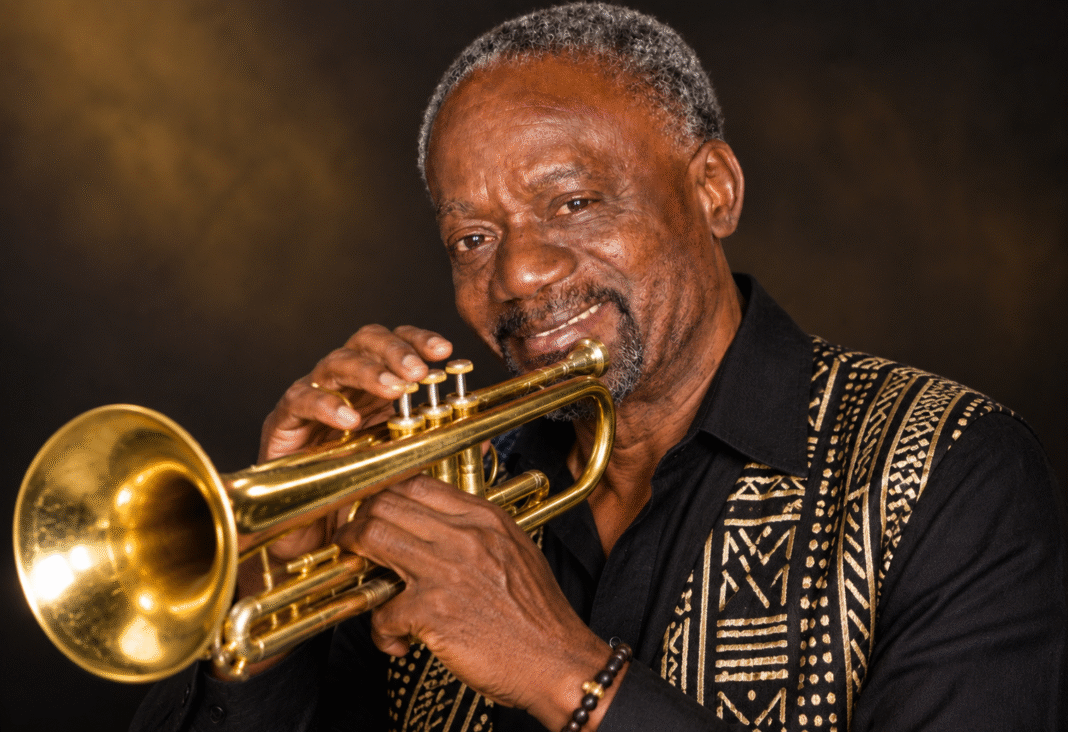
HMI Magazine remembers the legendary trumpet player, composer and arranger whose unmistakable brass sound helped make Les Frères Déjean de Pétion-Ville one of the great institutions of Haitian music
Haitian music has lost another giant.
André Déjean, the legendary trumpet player, composer, arranger and one of the creative pillars of Les Frères Déjean de Pétion-Ville, died Friday, September 11, 2026, in Florida. He was 75.
His passing represents far more than the death of an exceptional instrumentalist. It marks the departure of one of the musicians who helped define an entire period of Haitian popular music—an era when orchestration mattered, rehearsals demanded discipline, arrangements were carefully constructed and a horn section could become the unmistakable signature of a band.
For generations of Haitian music lovers, you did not always need someone to announce that Les Frères Déjean were playing.
You could hear the horns.
And among those horns, you could hear André Déjean.
The trumpet has fallen silent.
The sound has not.
FROM PÉTION-VILLE CAME A MUSICAL DYNASTY
The story begins in Pétion-Ville.
Historical accounts trace Les Frères Déjean to 1963, when Lyonel Déjean established a group originally known as Les Frères de Pétion-Ville, which would become Les Frères Déjean.
André emerged as one of the fundamental members of the ensemble, alongside members of the Déjean family including Fred Déjean.
André had developed his musical foundation at the Lycée de Pétion-Ville, where he participated in the school band. His musical environment included figures who would later become important names in Haitian music.
He eventually developed into far more than a trumpet player.
He played trumpet and trombone.
He composed.
He arranged.
He helped shape the orchestra’s musical direction.
And most importantly, he developed a recognizable musical voice.
WHEN EVERYONE WENT SMALL, THE DÉJEANS THOUGHT BIG
Understanding André Déjean’s importance requires understanding what was happening to Haitian popular music during the 1960s.
The rise of the mini-jazz movement was changing the architecture of Haitian bands. Younger musicians were increasingly attracted to smaller ensembles built around guitars, bass, keyboards and compact rhythm sections.
Les Frères Déjean moved differently.
They preserved the power of brass.
Trumpet.
Saxophone.
Trombone.
Instead of treating the horn section as an artifact of an older orchestral era, the Déjeans made brass sound contemporary.
That decision became their identity.
André’s trumpet and Fred Déjean’s saxophone helped create a musical conversation unlike that of many competing groups.
The arrangements could be elegant.
They could be muscular.
They could swing.
They could become romantic.
And when the entire brass section entered an arrangement together, there was little doubt about which orchestra was playing.
It became the Déjean signature.
ANDRÉ DIDN’T SIMPLY PLAY THE TRUMPET—HE SPOKE THROUGH IT
Great instrumentalists are recognizable before the listener knows what song is playing.
André Déjean belonged to that category.
His trumpet could be technically demanding without becoming cold. His phrases could move rapidly and precisely, but melody remained central.
There was joy in his playing.
There was discipline.
There was sophistication.
And there was personality.
His ability to move through fast passages and construct memorable melodic phrases became an important part of the band’s recordings.
One of the clearest examples remains “Marina.”
For generations of listeners and trumpet players, André’s celebrated solo became inseparable from the composition itself.
That is one of the highest accomplishments an instrumentalist can achieve.
Eventually, the solo is no longer merely something played on the record.
It becomes part of the song’s identity.
FROM HAÏTI TO BOUKI AK MALICE
Les Frères Déjean took time to establish themselves commercially, but once their recorded catalog began developing, the group created music that would survive far beyond its original era.
Their first album, Haïti, appeared in 1974.
It was followed by recordings including Pa Gain Panne and International before the group reached one of its defining periods with Bouki ak Malice in 1977.
That album produced enduring classics including “Débaké” and “Arrêté.”
The group’s creative momentum continued with L’Univers in 1979 and albums including Non Stop, First Class, Sans Rancune and Malere during the years that followed.
Songs such as “Marina,” “Débaké,” “Arrêté,” “Bouki ak Malice,” “Naïde,” “La Foi,” “Malere,” “Macaron” and others became part of a catalog that continued circulating at Haitian dances, on radio, through DJs and across generations.
André Déjean wrote or arranged a number of important works associated with that repertoire.
That is why calling him merely “the trumpet player from Les Frères Déjean” does not adequately describe his contribution.
He helped architect the music.
A SOUND THAT TRAVELED BEYOND HAITI
Les Frères Déjean did not remain a Pétion-Ville phenomenon.
Their music traveled throughout Haiti, into the Haitian diaspora and across the French Caribbean.
Martinique, Guadeloupe and French Guiana developed particularly strong relationships with Haitian Konpa, and the Déjean sound became part of that exchange.
André’s death was consequently mourned beyond Haiti.
That regional influence deserves recognition because Haitian musicians helped shape Caribbean popular culture far beyond the country’s borders.
Long before today’s vocabulary of “global music” and “crossover,” Haitian bands were already traveling, exchanging musical ideas and building audiences across linguistic and national boundaries.
Les Frères Déjean were part of that history.
JAZZ, BLUES AND KONPA COULD LIVE TOGETHER
Another reason the Déjean legacy remains important is musical sophistication.
The band’s arrangements demonstrated that Konpa could remain deeply danceable while incorporating the harmonic and instrumental vocabulary associated with jazz and blues.
André understood that relationship.
His trumpet was capable of improvisational freedom without losing the discipline required by the orchestra.
That balance matters.
A soloist can demonstrate technical ability.
A great band musician understands when to demonstrate it.
André’s musicianship existed inside the architecture of the ensemble.
He could step forward.
Then he could step back.
The song always remained larger than the musician.
That is the discipline of an orchestral player.
THE MUSICIAN BEHIND THE MUSIC
Accounts of André Déjean’s career repeatedly emphasize something younger musicians should study: discipline.
He belonged to a generation for whom becoming a professional musician meant more than appearing onstage.
You practiced.
You rehearsed.
You learned arrangements.
You understood harmony.
You listened to the other musicians.
You learned when not to play.
That philosophy contributed to the precision for which Les Frères Déjean became known.
André’s reputation among fellow musicians rested not only on talent but on musical knowledge and attention to detail.
That distinction is important.
Talent can create an impressive moment.
Discipline creates a career.
André Déjean’s career lasted for decades.
HIS MUSIC CONNECTED GENERATIONS
One measure of a musician’s relevance is whether his work survives the musical generation that produced him.
André’s did.
Later in his career, he continued interacting with younger Haitian musicians and even performed with artists associated with subsequent generations of Konpa, including Arly Larivière and Nu-Look.
That is significant.
The Haitian music industry changed dramatically from the 1960s to the digital era.
Big orchestras became mini-jazz groups.
Mini-jazz gave way to other band configurations.
Synthesizers became dominant.
Digital technology transformed recording.
New generations developed new approaches to Konpa.
Yet André Déjean remained musically relevant because musicianship travels across generations.
A great trumpet tone does not become obsolete because technology changes.
Neither does a great arrangement.
RECOGNITION FROM HAITI
André’s contribution eventually received recognition at the national level.
He was among distinguished Haitian musicians honored by the Haitian state for contributions to the country’s musical culture and for helping carry Haitian music beyond its borders.
But perhaps his greater honor exists outside official ceremonies.
It exists whenever a Haitian musician studies one of his solos.
Whenever a DJ plays a Déjean classic.
Whenever an older listener hears the opening notes of “Débaké” and remembers a dance from decades ago.
Whenever someone says:
“Sa se Déjean.”
That is cultural immortality.
ANOTHER GIANT OF HAITIAN MUSIC IS GONE
André Déjean’s passing arrives during a painful period for Haitian music.
The community is still processing the loss of other major figures from the generation that built modern Haitian popular music.
Every departure raises the same uncomfortable question:
Who will preserve what these musicians knew?
Not merely their recordings.
Their knowledge.
Their arrangements.
Their rehearsal methods.
Their stories.
Their understanding of rhythm.
Their understanding of orchestration.
Their understanding of what made Haitian music Haitian.
A generation of extraordinary musicians carried much of that information through lived experience rather than textbooks.
As they leave us, preservation becomes urgent.
HMI MAGAZINE ANALYSIS: WHY ANDRÉ DÉJEAN MATTERS
André Déjean deserves to be remembered for several reasons.
Obviously, he was an extraordinary trumpet player.
But his historical importance goes deeper.
He helped demonstrate that brass could remain central to modern Konpa at a time when the architecture of Haitian bands was changing.
He contributed as a composer and arranger rather than functioning solely as an instrumentalist.
He helped establish a recognizable orchestral identity.
And he belonged to a group whose longevity demonstrated that musical sophistication and popular dance music did not have to exist in separate worlds.
Perhaps most importantly, André represented a philosophy of Haitian musicianship.
Learn your instrument.
Respect the arrangement.
Respect the audience.
Respect the orchestra.
And create something identifiable enough that people know who you are before anyone announces your name.
Les Frères Déjean accomplished that.
THE DÉJEAN SOUND MUST BE PRESERVED
HMI Magazine believes the death of André Déjean should inspire more than memorial performances.
The Déjean catalog deserves serious preservation.
Original recordings should be restored wherever possible.
Master tapes should be identified and digitized.
Scores and arrangements should be archived.
Interviews with surviving musicians and family members should be documented.
Young Haitian horn players should study André’s solos.
Music schools and Haitian cultural organizations should teach the history of the orchestra alongside the history of Nemours Jean-Baptiste, Webert Sicot, Tabou Combo, Skah Shah, Magnum Band and the other institutions that shaped Haitian popular music.
Because if Haitian people do not document their musical history, eventually someone else will tell that history for them.
And pieces will disappear.
A TRUMPET THAT WILL NEVER COMPLETELY GO SILENT
Death ends a performance.
It does not necessarily end a musician.
Put on “Marina.”
Listen to the trumpet.
Play “Débaké.”
Listen again.
Return to “Arrêté.”
Listen to how the brass enters the arrangement.
Those notes were recorded decades ago, yet they still move.
They still breathe.
They still make people dance.
They still teach younger musicians.
That is André Déjean’s victory over time.
He came from Pétion-Ville and helped build a musical institution whose sound traveled throughout Haiti, the Caribbean and the diaspora.
He transformed breath into brass.
Brass into melody.
Melody into memory.
And memory into heritage.
On September 11, 2026, André Déjean played his final earthly note.
But somewhere tonight, in Port-au-Prince, Pétion-Ville, Miami, New York, Montreal, Paris, Martinique, Guadeloupe or French Guiana, someone will press play.
The horns will enter.
And André Déjean will be there again.
HMI Magazine extends its deepest condolences to the Déjean family, his fellow musicians, friends, collaborators and generations of listeners who grew up with the unmistakable sound of Les Frères Déjean de Pétion-Ville.
Rest in power, Maestro André Déjean.
The trumpet may be silent. The Déjean sound is forever.