
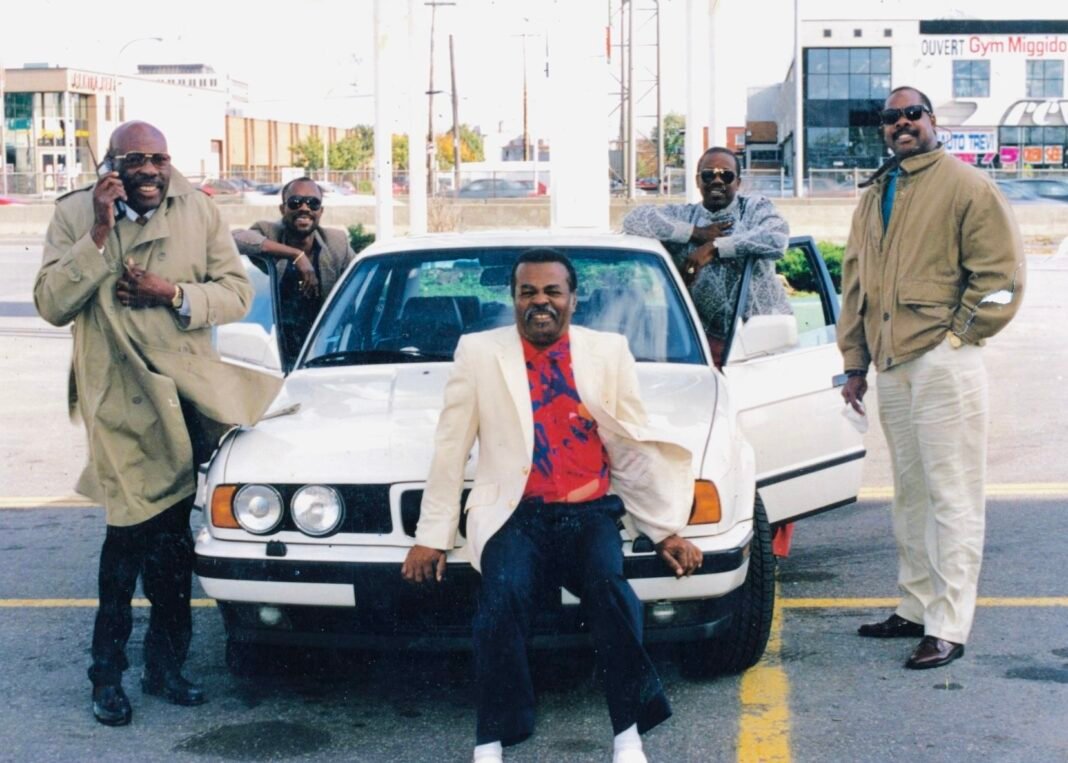
How a Football Star Became a Musical Icon and Gave Haiti Its Most Fearless Voice in Konpa Mamba
From Fonbwa to Fame: The Early Years
Jean Gesner Henri, known to the world as Coupe Cloue, was born on May 10, 1925, in the quiet town of Fonbwa, in the Léogâne commune of Haiti. At nine, he relocated to Port-au-Prince, settling in Portail Saint Joseph. He pursued his education there at Chez Laroche on Rue du Centre and later attended the Centre des Arts et Métiers. Henri began shaping his creative and professional paths at this technical school—learning cabinetry and discovering music, with the trumpet as his first instrument.
Football Field Genius: Where the Nickname Began
As a teenager, Henri moved to Bel Air and emerged as a formidable football player, first with Etoile Haïtienne and then Bacardi. At 25, he co-founded Aigle Noir Athletic Club alongside Michel Blain, Edner Bataille, and Marc Elie. On the field, Henri impressed spectators and teammates with his signature move: stopping a fast-moving ball and launching it back with fierce precision—a technique he proudly called “Coupe Cloue,” borrowing from his carpentry background (“cut and nail”). The nickname stuck, and soon, everyone knew him as Coupe Cloue.
Music also remained a steady companion. He would sing and play guitar before matches or during team curfews, quietly planting the seeds for his lasting legacy.
Trio Select and the Birth of a Movement
Henri’s musical talent evolved during informal jam sessions with local musicians from Trio Crystal. In 1956, he left behind the world of sports to pursue music full-time. On September 6, 1957, he formed Trio Select, introducing a style rooted in traditional Haitian troubadour but infused with his unique energy and humor. He actively promoted his music on radio stations like Radio Caraïbes, Radio Quisqueya, and Radio Haiti.
Their first central performance at Théâtre de Verdure—opening for Jazz des Jeunes—made an immediate impact. Soon after, they released their debut album, produced by Marc Duverger, featuring the work of gifted guitarist Bellerive Decelian. Bellerive’s elegant yet revolutionary guitar style helped redefine Haitian music by elevating the guitar to a lead instrument—a move that would later influence the “Mini Jazz” explosion of the 1960s.
The Evolution of Ensemble Select
By 1973, Trio Select had evolved into L’Ensemble Select, adding a fuller, more dynamic sound. Talented musicians like Prosper Saint Louis, Colbert Desir, and Jean René Petion brought new life to Coupe Cloué’s evolving vision. The group’s Carnival hit, “Men Rat La,” marked a significant cultural moment, combining humor, social insight, and irresistible rhythm.
As their sound matured, they welcomed singer Assade Francoeur. Francoeur’s smooth vocals and emotional ballads, like “Marie Jocelyne,” created a perfect counterbalance to Coupe’s biting wit and raw social commentary in songs like “Shada” and “Sociss.” Francoeur’s contributions—44 songs—deepened the band’s musical catalog and broadened its appeal to a new generation.
Global Tours and Cultural Recognition
By the late 1970s, Coupe Cloue and Ensemble Select were international sensations. From the Caribbean islands to North America and even Africa, the band spread the infectious Kompa Mamba sound. In 1979, Coupe Cloue was honored on the Ivory Coast as a global music dignitary—one of the first significant acknowledgments of a Haitian artist on the African continent.
Despite musical trends shifting toward digital sounds and French-Caribbean influences, Coupe Cloue remained fiercely authentic. In 1980, his Carnival song “Roi Coupe” crowned him metaphorically and musically as Haiti’s “King Coupe,” a title he carried with pride.
Final Years and Everlasting Legacy
The early 1990s changed the Haitian music scene, but Coupe Cloue maintained relevance with tracks like “Donki,” featured on the 1993 album Sa Ki Pou Ou. The album, produced by Jeff Wainwright and Ernst Louis, used modern computer sequencing and featured arrangements by Dadou Pasquet and Laurent Ciceron. Though he began slowing down due to health and age, Coupe’s influence never waned.
In 1997, he was honored at the Brooklyn Academy of Music with a Lifetime Achievement Award, followed by a televised tribute in Haiti. When he passed away on January 29, 1998, Haiti mourned one of its greatest icons.
A Lasting Echo
Coupe Cloué’s legacy transcends music. His Konpa Mamba style fused storytelling, humor, and rhythm in a way that spoke directly to the Haitian experience—unfiltered, unrelenting, and unforgettable. For over four decades, he gave voice to a nation, tackled social issues head-on, and brought joy through a sound that still resonates today.
The HMI Magazine Expert Commentary:
“Coupe Cloue wasn’t just a musician—he was a mirror of Haitian society. With unmatched wit, charisma, and authenticity, he built a legacy no artist has since dared to replicate. His invention of Kompa Mamba gave Haiti a new genre and a way of expressing truth through music. For his extraordinary influence, global reach, and fearless originality, Jean Gesner Henri rightfully earns his place in The HMI Magazine Hall of Fame.”
The Haitian Music Industry Magazine Editorial Board –


